
Terra Infirma
ΔS, “implicit stability assumption” and translating science to economics in a courtroom

In a 2016 courtroom, there was a striking moment of moral clarity without legal consequence, scientific certainty without remedy.
Judge Ann Aiken of the U.S. District Court in Oregon issued one of the most remarkable decisions in modern environmental litigation. She ruled in favor of the youth plaintiffs in Juliana v. United States — the young Americans who argued that federal climate and energy policies violated their constitutional rights.
She recognized, for the first time in federal court, that a “climate system capable of sustaining human life” is a fundamental constitutional right. She acknowledged that the U.S. government had materially contributed to the climate crisis. She accepted the science. She even recognized that the plaintiffs would suffer because of it.
Then came the words that would ultimately doom the case. To paraphrase:
Yes, the government harmed you.
No, the law cannot help you.
She explained that courts could not “redress” the injury — not because the harm wasn’t real, but because fixing it would require a sweeping policy overhaul beyond judicial power. The Constitution does not give courts authority to order the federal government to redesign its economic and energy systems. The injuries were real; the law simply could not reach the remedy they seemed to demand.
Judge Aiken allowed the case to proceed anyway. But in January 2020, the Ninth Circuit Court of Appeals dismissed it for lack of Article III redressability, concluding that the harms were undeniable yet beyond the judiciary’s power to rectify. And in March 2025, the U.S. Supreme Court declined to review the Ninth Circuit’s decision, closing the door on the Juliana case for good.
The kids did not lose because the science was wrong. They lost because the courts lacked a legally cognizable way to translate that science into the economic and structural markers that define what judges can construe as harm.
The rebuttal to Juliana’s cautionary tale, that I am trying to make clear, is to ask the courts to remedy an injury type that does fall within their limitations — and produces a better legal outcome even if couched in alternative terms.
It’s a challenge of assumptions. The courts correct flawed assumptions all the time: revising flawed models, rejecting irrational inputs, and requiring those with legal powers to base decisions on accurate information. However, in the case of Juliana, the court failed to recognize that the assumptions used to deny harm are incorrect.

Implicit Stability Assumption
The puzzle of Juliana is bigger than climate litigation. It touches the foundation of how modern society measures risk, value, and responsibility. It exposes something invisible, something woven into the formulas that structure the economy, federal policymaking, fiduciary governance, and the mathematical architecture of law — even ballot-box outcomes.
The assumption is simple: Earth, as a system, is constant. Stable. Fixed. In economic notation, the assumption is that S = 1.
Whether or not S = 1 appears explicitly in the equations, every major economic model rests on the same hidden premise: a stable, unchanging Earth beneath economic activity. In math, anything multiplied by 1 stays the same. So the biophysical substrate that makes civilization possible is flattened into a benign constant — reliable enough to ignore, even though its stability is the precondition for everything built atop it: a functioning economy, a functioning society, a livable habitat.
The result is an implicit stability assumption: Earth’s life-support systems remain steady enough to leave out of the math. It never appears in the equations, but it governs them all.
This assumption predates climate science itself. Gross Domestic Product — the most powerful number in public life — arose from 1930s national accounting and was finalized in the 1950s. It never included Earth-system stability and still doesn’t. Modern Portfolio Theory, born in the same era, assumes stable return distributions because a shifting planetary baseline was literally unimaginable at the time — a limitation its creator, Harry Markowitz, later admitted.
Actuarial science, the discipline we trust to quantify future risk, formed in the late 19th and early 20th centuries, during the Holocene — a 12,000-year window of extraordinary planetary stability. Climate, hydrology, and ecological systems barely moved across all of recorded human history. So actuaries assumed stationarity: the idea that the statistical properties of the world stay constant through time.
But stationarity was never a law of nature. It was a geological grace period. And actuarial math has never been updated for the moment that grace ended.
Which assumption matches reality —
Earth-as-constant or Earth-as-variable?
Over the past half-century, Earth-system science has produced a very different picture: one of a planet whose stability is not constant but contingent, not fixed but delicately balanced across multiple interacting boundaries. Atmospheric carbon, land-use change, ocean acidity, nitrogen loading, biosphere integrity — each of these reflects a dimension of the planet’s life-support capacity, and each is changing. The Stockholm Resilience Centre’s 2023 paper (and summary) shows that six of nine planetary boundaries it measures are already in overshoot, including biosphere integrity, the foundation of ecological function itself. These findings do not merely show ecological damage; they show measurable declines in Earth-system capacity to support civilization and economy.
This means the convenient premise beneath our economic models — the implicit stability assumption — has never been true, and now can be proven false.
This is the structural blind spot of modern law that governs how the economy works within, or outside, planetary boundaries.
In other words, we now know better and continuing to rely on a false assumption is a choice.
Today, law and finance still operate as if S = 1. Courts rely on economic models that treat environmental destabilization as an externality rather than a variable. Fiduciary boards, overseeing trillions in pension wealth, still use risk tools and solvency forecasts that assume stable planetary conditions indefinitely into the future. Policymakers, regulators, and investment consultants all use formulas that only work when S = 1, even as the science shows that S ≠ 1.
This mismatch between science and economics is not a philosophical problem. It is a modeling error. And because the law follows the errant model, it is also a justice problem.
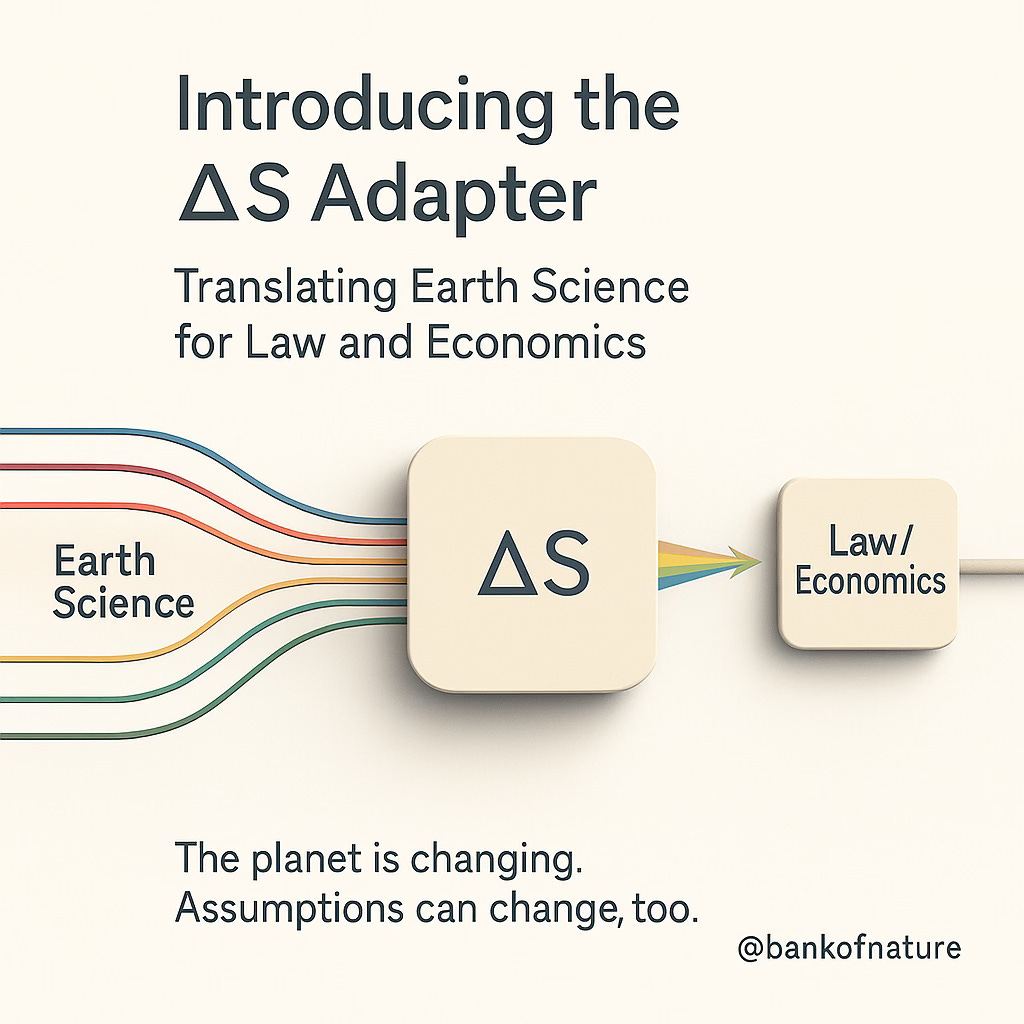
ΔS is a science-to-law adaptor
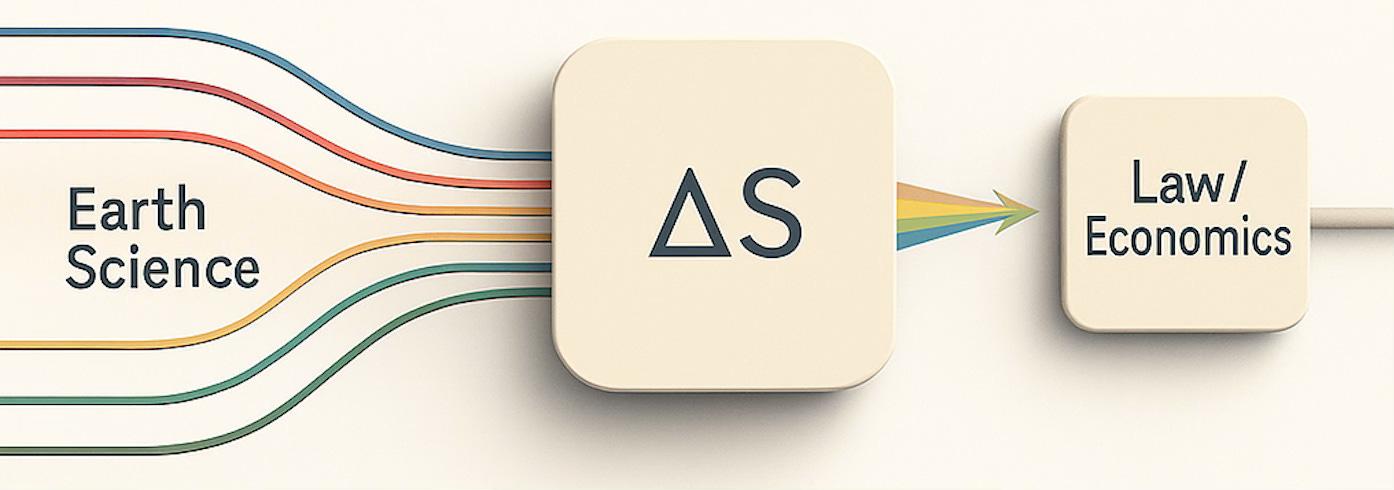
ΔS is a science-to-law adaptor — a simple translation term that lets real-world destabilization enter the economic and legal formulas courts already rely on. It is not a model of the planet, not a price on nature, not an index, and not an ecosystem-services metric. It fixes something far more basic: the assumption.
ΔS doesn’t compress Earth’s complexity into a number. It exposes the outdated scalar hiding inside the math — the false premise that S = 1. Its purpose is modest and necessary: to replace a silent constant with a real variable, so that harm can finally appear in the equations designed to detect it.
When you expose a false assumption in law or finance, the burden shifts. You no longer must prove harm “to the penny.” You only must show that the assumptions used to deny harm cannot rule it out. ΔS makes that shift possible. It breaks the illusion of stability that makes environmental injury legally invisible.
This is the hinge that explains why cases like Juliana fail. The court accepted the science, but the remedy depended on economics — and the economics were built on S = 1. Under that premise, no combination of emissions, policy choices, or planetary destabilization can be represented in legally actionable terms. Harm is real, but not redressable. Without redressability, there is no standing. Without standing, there is no case.
ΔS changes the redressability analysis because it reframes the injury as an error of assumption, not a demand for macroeconomic redesign. It reframes the injury not as “the climate is collapsing” but as “the government relied on an invalid assumption in the models that structure its decisions.”
Courts do not need to reorder the economy or dictate policy to remedy this harm. They only need to correct the assumption. And at least one court has already done exactly that.
Held v. Montana is the first U.S. environmental justice case in which a court struck down a statutory assumption that treated Earth-system variability as zero — effectively an S = 1 mandate. Montana law barred state agencies from considering greenhouse gas emissions or climate impacts in environmental reviews. The court held that this categorical omission violated the state constitution.

In ruling for the youth plaintiffs, Held affirms the core principle behind ΔS: once environmental variability is scientifically established, decision-makers cannot rely on frameworks that pretend it isn’t there.
None of this requires a national climate plan. None of it violates separation of powers. These are routine judicial functions — correcting an irrational assumption in the models government relies on.
A model built on a false premise cannot be used to deny injury. Once ΔS shows that S is not constant, courts can require agencies — or fiduciaries — to revise the assumption, reopen the analysis, and incorporate destabilization into their risk models. That is a familiar, judicially comfortable remedy. It fits within existing authority. It does not ask courts to solve climate change — only to correct an error in the math.
The impact of a ΔS does not stop at climate litigation
The hidden “implicit stability assumption” runs straight through the structure of the financial world — and especially through the part of it governed by fiduciary duty.
Defined-benefit pension funds, endowments, foundations, trusts, and insurance pools collectively manage between $30 trillion and $100 trillion globally. This is money with strings — money governed not by preference or ideology but by legal obligations of prudence, loyalty, and impartiality. The decisions fiduciaries make must be justified using the economic tools accepted by law. And all those tools assume a stable substrate. They assume S = 1.
The formulas that guide fiduciary decision-making — expected return calculations, discount-rate reasoning, solvency projections, diversification models — all rely on risk distributions that presume substrate stability. They assume that past performance patterns are reliable indicators of future conditions because the underlying system is constant. They assume that diversification across sectors and geographies will protect the portfolio because shocks are random rather than systemic. They assume that actuarial projections can be calculated over 30-year horizons because the planet that makes economic activity possible is not shifting underneath them.
These assumptions no longer match the state of planetary health. Climate risk is not an externality. Boundary overshoot is not a “scenario.” Substrate destabilization is not a background condition that can be safely ignored. When S changes, long-term return distributions shift. Diversification breaks down. Solvency projections weaken. Risk becomes endogenous rather than random. And the legal foundation for fiduciary prudence begins to crumble.
ΔS makes this gap visible. It provides the missing connective tissue between Earth-system science and fiduciary duty, converting destabilization into foreseeable risk — the standard that governs prudent behavior. A fiduciary model built on an invalid assumption is not prudent; it is defective. Once ΔS shows that S ≠ 1, every risk model, return projection, and solvency analysis that relies on a constant substrate must be reconsidered. This is not activism. It is compliance.
This tiny correction leads to massive change in the way money moves toward or away from substrate stabilization -- many, many trillions that must be adjusted for ΔS.
If the 7% assumed rate of return for pension fiduciary performance depends on S = 1, and S is not constant, then the 7% number is not a forecast — it is an error in pricing that does not factor climate risk. If diversification strategies depend on stable correlations that break down under destabilization, then diversification is not a hedge — it is an illusion. If actuarial solvency depends on return distributions that only hold under stationarity, then solvency projections are overstated. If fiduciary impartiality requires equitable treatment of future beneficiaries, but the math hides their exposure to systemic collapse, then impartiality itself is violated.
ΔS does not compel divestment for moral reasons. It simply reveals that certain assets — fossil fuels, deforestation-linked agriculture, climate-exposed infrastructure — depend on S = 1 for their expected performance. When S moves, their long-term risk-adjusted returns become invalid. The question for fiduciaries shifts from “Should we divest?” to “Why are we holding assets whose performance depends on a false assumption?” That is the prudence question.
The same logic applies to beneficiaries. Without ΔS, courts often dismiss climate-related fiduciary claims as speculative. With ΔS, the injury is concrete: the fiduciary relied on a model that cannot rule out foreseeable harm. Beneficiaries do not need perfect precision; they need only show that the model used to justify a decision rests on an assumption the fiduciary knows to be false. ΔS gives them that leverage.
This shift is more than legal. It is architectural. Once prudence shifts, capital follows. The financial system that shapes the actual, direct economy begins to realign. Investment flows move toward enterprises that stabilize S rather than degrade it — not because they are green or virtuous, but because they are aligned with the conditions required for solvency and long-term value. The fiduciary system becomes a mechanism for building a future in which its own promises can still be kept.
Asking Juliana differently
It is important to be clear about what ΔS does not do. It does not claim to condense the complexity of the planet into a single metric. It does not attempt to model nonlinear tipping points or produce a comprehensive ecological valuation. It is not an ecosystem-services framework, an ESG score, or a new form of green accounting. ΔS is not a substitute for Earth-system science. It is a doorway into the legal-economic architecture that governs the world.
ΔS takes the simplest, most widely accepted fact in Earth-system science — that the planet’s stability is changing — and makes it legible inside the formulas built on the assumption that it is not. It exposes the contradiction. And once the contradiction is visible, the law cannot unsee it.
A constant Earth assumption is now a liability, a source of blindness in law and finance, a barrier to recognizing harm and acting on it.
Breaking that assumption does not solve the climate crisis. But it solves something adjacent and essential: the legal and financial invisibility of the crisis. It makes room for responsibility to exist. It aligns the math with the world. It gives courts a remedy and fiduciaries a duty. It brings the planet back into the equations that shape our future.
ΔS does not fix Juliana’s facts — those were already accepted. It fixes Juliana’s framing. And once you fix the framing, the law can finally reach the harm.
What if the constitutional injury isn’t the climate system at all, but the faulty assumptions embedded in the systems that govern it?
This is how ΔS changes Juliana’s outcomes: It doesn’t overturn the case; it rewrites the Juliana 2.0 question into one courts have always had the power to answer. Are the assumptions correct?
Juliana’s injury was planetary; ΔS’s injury is mathematical, procedural, and well within the judiciary’s traditional authority. ΔS reframes the harm not as “the government failed to stop climate change,” but as “the government and fiduciaries rely on models that assume a stable Earth when the Earth is no longer stable — and that false assumption causes predictable financial, intergenerational, and constitutional injury.”
It’s the same false assumption in every jurisdiction anywhere in the world that makes economic decisions on S=1. ΔS travels.
Ian: What you write is spot on: “once environmental variability is scientifically established, decision-makers cannot rely on frameworks that pretend it isn’t there.”
In other words: banks, investment funds, pension schemes, and other fiduciaries (and courts enforcing fiduciary duties) can no longer assume that diversification of investments is enough to minimize risks and maximize returns. They have to take into account that if we keep doing business-as-usual, the system is subject to a risk of tipping and collapse. Their investment allocation and management must therefore be geared towards maintaining the stability of the system. That means transitioning to clean energy and industry, sustainable practices, and nature preservation. Because without those, we (and our economy) cannot survive.
I think the beauty of the principles of fiduciary duties is that they actually already accommodate this – and indeed require this – because fiduciaries have to do what is in the best interest of beneficiaries, including future beneficiaries. In other words, the obligation to allocate and manage investments in a way that restores and maintains economic system stability (and therefore Earth system stability) follows from current, well-established principles of fiduciary duties and needs no new legislation.
Courts can and should enforce that *already today*. We discuss this in our paper "Sustainable Fiduciary Duties for Investors -- How fiduciary duties can be a key to escape the climate prisoner’s dilemma", https://papers.ssrn.com/sol3/papers.cfm?abstract_id=4962416
Let’s hope that this is confirmed in the recently filed case of Hirji et al v Canada Pension Plan Investment Board, File CV-25-00754169-0000 (application of 23 October 2025).
Yet again - utter brilliance and eloquence.