
The New Bargain
Middle Powers and the Capital That Already Lives in Mark Carney’s Values-Based Realism

Part I — When Stability Becomes Exposure
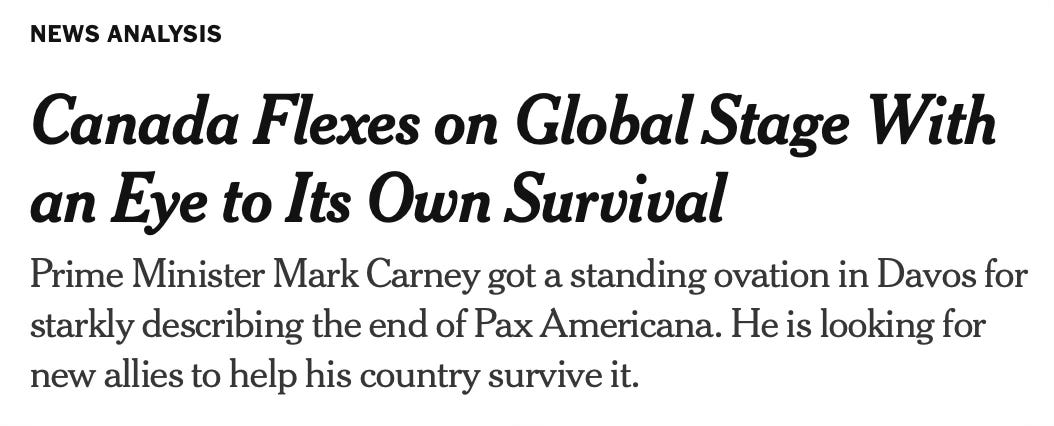
Mark Carney’s recent Davos speech drew a rare and consequential line in the geopolitical sand. In plain terms, he named what middle powers have long lived with but rarely said aloud: the bargain underpinning the postwar international order no longer works. His talk reframed the informational environment in which common sense itself must now be assessed — by states, by institutions, and by any actor whose obligations extend beyond the next quarter or election.
The Canadian Prime Minister acknowledged that American hegemony — during post-WWII rebuilding and globalization — offered middle powers a way to navigate upheaval and build sovereign capacity through alignment with U.S.-led trade, monetary stability, collective security, and dispute-resolution frameworks. The hypocrisy embedded in that arrangement was tolerable as long as it was predictable and reduced risk.
“We knew the story of the international rules-based order was partially false, that the strongest would exempt themselves when convenient, that trade rules were enforced asymmetrically, and that international law applied with varying rigor depending on the identity of the accused or the victim. This fiction was useful. This bargain no longer works.”
— Mark Carney, Davos 2026
That balance has now inverted. Two decades of financial, health, energy, and geopolitical crises, Carney argued, have exposed the fragility of extreme global integration. A world order once believed to reduce risk now concentrates it.
Permission no longer insulates. Appeasement no longer translates into protection. Continued reliance on a hegemon whose commitments are increasingly contingent and coercive is no longer prudent planning. It is exposure.
Naming this inversion breaks the long-running pantomime of supporting a status quo even as great powers weaponize integration itself: tariffs as leverage, financial infrastructure as coercion, supply chains as instruments of pressure. Remaining embedded in a system that now degrades economic security, environmental stability, and social cohesion is no longer a passive condition, but an active decision with consequences that dependents already feel through hardship, dissonance, and alienation.
By declaring the old bargain unworkable, Carney resets the bar of global expectations. There is a before the speech and an after. He makes it possible to discuss alternatives — coordination without permission, legitimacy without dominance — that were previously unsayable in rooms like Davos.
The immediate reaction to his speech illustrated the point. Trump’s threat of a 100% tariff on Canada — explicitly linked to Carney’s Davos posture and Canada’s outreach to China — was weaponized integration performed in real time. It was confirmation.
Part II — The Cost of Standing Still
“You cannot live within the lie of mutual benefit through integration when integration becomes the source of your subordination.”
— Mark Carney, Davos 2026
Since WWII, the international “system” has endured repeated ruptures — ideological, financial, technological, environmental, and social. What made earlier ruptures survivable was not their resolution, but their absorption. Costs were pushed outward — into the environment, weaker economies, social fabric, or the future. That displacement functioned as slack. Continuity was maintained because consequences were externalized faster than they fed back.
That slack is now gone — a key reason Carney’s warning lands as fresh. The status quo has run out of places to hide its own byproducts. The threshold is already behind us.
Where inherited scripts once masked misalignment, they now deepen it.
Where systems appeared stable, they now look brittle.
Where critique sounded theoretical, it has become operational.
This is a consequence of scale.
Globalization has closed the escape hatches. There is no “outside” anymore. Planetary boundaries are observable. Universal ownership and industrial correlation mean diversification no longer insulates. Intergenerational liabilities mean consequences can no longer be deferred. Systems can no longer externalize error without feeding it back into themselves.
At the same time, duration has outrun assumptions. Institutions authorized under one informational regime now operate in another — reshaped by climate science, geopolitical weaponization, systemic risk, and demographic change.
Feedback loops have shortened. What once took generations to surface now appears within tenures, careers, and lifetimes. A sociological fiction — that costs could always be displaced — has become a governance problem.
Middle powers can see this plainly. Supply chains have become leverage. Financial infrastructure is used coercively. Security guarantees are revealed as contingent. Retaliation increasingly harms the retaliator. Staying aligned with an unpredictable hegemon now carries higher expected downside than making a break.
What Carney invites is a change in behavior: coordination rather than deference, shared exposure rather than delegated risk, legitimacy earned through consistency rather than protection. His values-based realism recognizes that legitimacy now flows from alignment under shared exposure — not exemption granted by dominance.
The question that follows is not whether a post-hegemonic world is imaginable, but who is already structured to live in it.
Part III — The Capital Already Living in the New Bargain
“Canada has what the world wants. We are an energy superpower. We hold vast reserves of critical minerals. We have the most educated population in the world. Our pension funds are amongst the world’s largest and most sophisticated investors.”
— Mark Carney, Davos 2026
If middle powers are the only plausible agents in a post-hegemonic world, the central question is no longer only how they coordinate, but who qualifies as a middle power once exposure — not dominance — defines legitimacy. Under those conditions, qualification turns on the capacity to underwrite coordination under pressure.
Carney’s answer is telling. Among the many financing options available, he explicitly names Canada’s pension funds. This is not a tangent. It is a hinge — especially coming from a leader with a doctorate in economics, former head of two major central banks, and a long-time advocate for rethinking the role of finance under changing conditions. The signal is not about aspiration, but about where durable capacity already resides.
Banks can move. Venture capital can exit. Mobile finance can hedge, arbitrage, and withdraw when conditions deteriorate. Pension funds cannot. They already exist as long-duration capital that must live with the consequences of systemic risk.
Defined-benefit pension funds are not nation states. They do not conduct diplomacy or exercise statecraft. They exist to secure a dignified future for their beneficiaries — who, like everyone else, must live in the world their capital helps shape. Structurally, they resemble the middle powers Carney addresses more closely than any other class of capital in the global system.
They operate at sovereign scale.
They are intergenerational by design.
They cannot exit systemic instability.
Their liabilities extend across the same horizons as climate risk, geopolitical fragmentation, and social breakdown.
This is why pensions receive special mention where other forms of capital do not. They are not cited because they are benevolent or innovative, but because they are constrained in ways that confer agency under shared exposure. They cannot relocate their beneficiaries, shorten their obligations, or diversify away the conditions that determine whether those obligations can be met.
Precisely because of these constraints, they can internalize systemic risk as a fiduciary input, coordinate without waiting for permission, and commit capital in ways that prioritize durability over exit. Their limits are what make them capable of acting when insulation fails and consequences can no longer be deferred.
In that sense, defined-benefit pension funds already function as middle powers. They operate at scale without sovereign immunity, are globally entangled without the ability to externalize harm, and are governed by a legal framework — trust law — that already demands what Carney describes: realism about constraints, loyalty under shared exposure, and judgment when inherited assumptions no longer hold.
Seen through this lens, pensions are not an unconventional partner added to the picture. They are the consequence of the picture coming into focus.
Part IV — What This Recognition Changes
Recognizing that some institutions already live inside the new bargain changes what prudence now requires, because exposure is no longer hypothetical or deferrable. It collapses the illusion that coordination is optional, that exposure can be deferred, or that legitimacy can still be rented from a dominant power.
States cannot carry this alone. Diplomacy cannot negotiate away systemic risk. New institutions take decades to mature — and this moment does not have decades to spare. The world Carney describes demands actors that can act now, at scale, under constraint.
Fiduciary institutions, for their part, cannot substitute for states. They do not legislate, negotiate treaties, or provide security guarantees. But they already operate under the same conditions Carney identifies: long duration, universal exposure, and an inability to externalize harm without ultimately bearing it themselves.
This is the overlooked consequence of Carney’s intervention.
Once the old bargain is named as broken, inaction ceases to be neutral. For states, continued deference becomes a choice with escalating downside. For fiduciaries controlling capital at sovereign scale, continued reliance on inherited assumptions becomes a decision subject to scrutiny under existing law. What once passed as continuity now reads as exposure.
Prevailing fiduciary allocation practices continue to reinforce fragmentation, treating disorder as investable, securitizing volatility, and prioritizing defensive fortification over shared resilience. They reflect frameworks built for a world with an outside — one in which risk could be externalized, instability could be priced without consequence, and insulation could be purchased rather than earned.
In a closed, interdependent system, however, these same practices no longer disperse risk. They concentrate it, financing the fortresses that Carney warns against rather than the forms of coordination required to sustain a shared horizon.
What this reveals is not merely a mispricing of risk, but a misalignment of roles. States and fiduciaries have continued to act as if their responsibilities were separable, even as the conditions they face have converged.
What Carney makes newly visible is not a future event, but a present condition. Legitimacy now flows from consistency — acting in ways that can be defended under pressure, across time, and in full view of those who must live with the consequences.
Middle powers cannot build this alone. Fiduciary institutions cannot either. But together they occupy a space no hegemon can credibly fill: long-term, legitimacy-dependent, globally entangled, and unable to offload the costs of error onto others.
The question, then, is no longer whether a post-hegemonic world is imaginable. It is whether the institutions already living in that world will begin to act like it.